Convert your Quadratic Equation from Vertex Form to Standard Form below.
You will also understand how to
-Convert from Vertex Form to Standard Form - Step by Step.
-Find the Vertex of any Quadratic Equation.
-Deal with negative Leading Coefficients.
Enter the leading coefficients a and the vertex (h,k) in the red box above, next press the gray CONVERT button below to view the Standard Form
of your Quadratic Equation given in Vertex Form.
The Vertex Form of a Parabola is
$$ y=a(x-h)²+k $$
where
(h,k) are the Vertex Coordinates.
The Standard form of a Parabola is
$$ y=ax²+bx+c $$
Example: Convert from Vertex to Standard Form
Let $$ y=2(x-1)²-5 $$
we first apply the binomial formula to expand and get
$$ y=2(x²-2x+1)-5 $$
Next, we distribute the 2 to get
$$ y= 2x²-4x+2-5 $$
With 2-5=-3 we finally arrive at the Standard Form:
$$ y=2x²-4x-3 $$
We obtain the Standard Form from the Vertex Form by using these 2 steps:
Given: $$y=a(x-h)²+k$$
Step1: (Use Binomial Formula) $$y=a(x²-2hx+h²)+k $$
Step2: (Distribute and Combine the like terms ah² and k) $$ y=ax²-(2ah)x+(ah²+k) $$
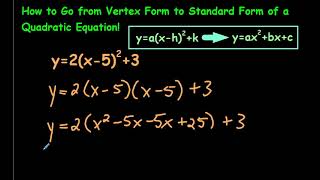
Video: How to Convert from Vertex Form to Standard Form of a Quadratic Equation
Every Parabola has either a..
..
Minimum (when opened to the top due to leading coefficient a>0) or
..
Maximum (when opened to the bottom due to leading coefficient a<0).
The Vertex is just that particular point on the Graph of a Parabola.
See the illustration of the two possible vertex locations below:

We are given the quadratic equation in vertex format
$$ y=-2(x+3)²-7 $$
First, apply the binomial formula
$$ (x+3)² = x²+6x+9 $$
Thus we have
$$ y= -2(x²+6x+9)-7 $$
Next, distribute the 2 to get
$$y= -2x²-12x-18-7 $$
Since -18-7=-25 we finally get the standard form
$$ y= -2x²-12x-25$$
Here, $$a=-2, b=-12, c=-25 $$ are the coefficients in the Standard Form
$$ y= ax²+bx+c $$
Get it now? Try our Vertex to Standard Form Calculator a few more times.